

Quick Summary
Dropshipping vs affiliate: dropshipping means selling physical products you never stock, earning your own margin but carrying the advertising and customer risk, while affiliate marketing means earning commission on other businesses’ sales with a lighter, lower-cost start that usually takes months to build.
- Affiliate marketing needs little upfront money, mainly your time and a domain and hosting.
- Dropshipping needs a test advertising budget, often £150 to £500 for the first month.
- Dropshipping margins depend on advertising cost per sale, not the headline supplier price.
- Affiliate commissions are capped by each merchant’s terms, which can change at short notice.
- Pick dropshipping for product control and a funded test budget; pick affiliate marketing for low cash risk.
Table of Contents
- Dropshipping vs Affiliate Marketing: What Each Model Actually Involves
- Dropshipping Startup Costs and a Realistic Beginner Budget
- Profit Margins, Break-Even and Example Unit Economics
- Affiliate Marketing for Beginners: Workload, Income Timelines and Risks
- Dropshipping for Beginners: Suppliers, Fulfilment, Returns and Customer Service
- Best Dropshipping Products for Beginners and How to Vet Them
- Choosing Your First Model: A Decision Framework and 30-Day Plan
- Frequently Asked Questions
Last Updated: 30 October 2026
Dropshipping and affiliate marketing both promise a route into online business without the cost of building a traditional company, but they ask for very different things from a beginner. New entrepreneurs often choose between the two based on headlines rather than on how each model actually works day to day. This guide compares dropshipping vs affiliate marketing for beginners, covering the workload, the money, and the risks, so you can decide which fits your skills and budget.
Dropshipping vs Affiliate Marketing: What Each Model Actually Involves
Affiliate marketing is promoting other businesses’ products and earning a commission on the sales you refer. You can see how our CPA and affiliate offering works in practice on that page. You do not own the product, hold stock, or handle delivery. Your job is to attract the right audience and send them to a merchant’s offer.
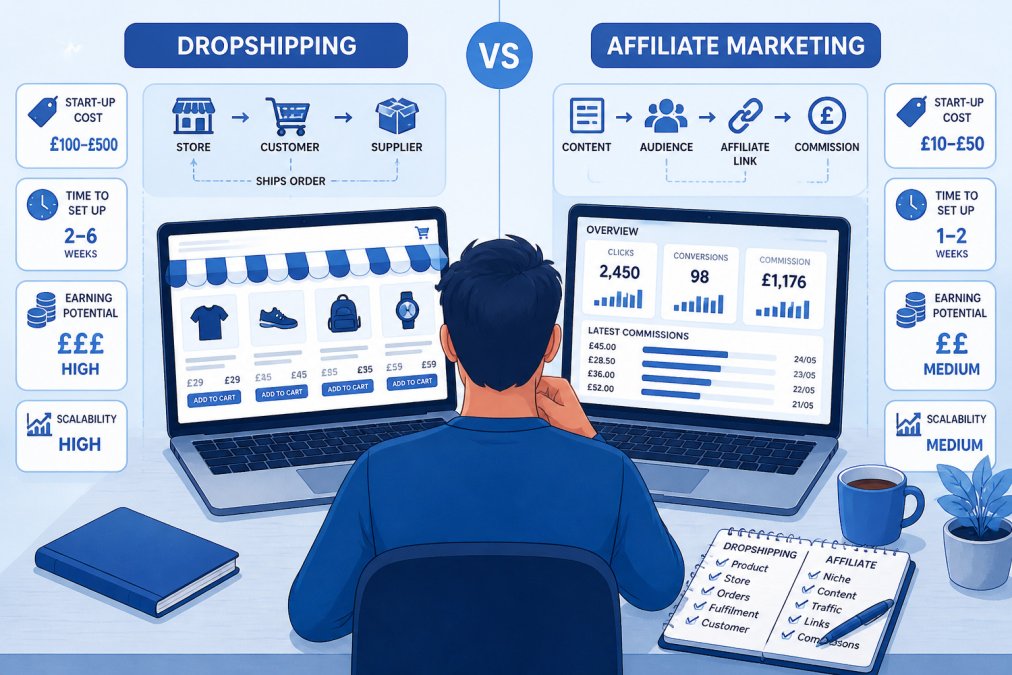
Dropshipping is selling physical products you do not stock yourself. A customer buys from your store, and a supplier ships the item directly to them. You control pricing and the customer relationship, but you also carry the responsibility for the sale.
![A UK entrepreneur at a home desk weighing two laptop screens side by side, one showing a storefront and one showing a referral dashboard, with a notepad and tea nearby | section:Dropshipping vs Affiliate Marketing: What Each Model Actually Involves]
How affiliate marketing earns commission
Affiliate income depends on a merchant paying you for each sale, lead or action your content generates. The merchant sets the commission rate, so your earnings are capped by their terms. Printful’s comparison describes affiliate marketing as promoting other businesses to earn commission on new sales, which is a useful starting point for understanding the model Printful’s comparison of affiliate marketing and dropshipping.
The upside is a lighter operational load. The downside is that you have less control over the offer itself.
How dropshipping earns product margin
Dropshipping earns the difference between your selling price and what you pay the supplier, plus shipping and fees. Because you set the price, your margin can be higher per sale, but you also absorb the cost of advertising, returns handling and customer support. Printful notes that sellers set their own prices in dropshipping rather than relying on fixed affiliate commission rates Printful’s breakdown of dropshipping pricing.
Dropshipping Startup Costs and a Realistic Beginner Budget
Dropshipping needs more upfront money than affiliate marketing because you must fund a store, product imagery, advertising and a buffer for early losses. Affiliate marketing can be started for close to the cost of a domain and hosting, but it costs you in time instead. The useful exercise is to build both budgets line by line rather than rely on a headline figure.
| Cost line | Typical first-month range | Ongoing monthly range | Notes |
|---|---|---|---|
| Domain name | £8-£15 per year | , | A .co.uk or .com registration; renewals are annual |
| Store platform | £0-£35 | £25-£35 | Entry e-commerce plans sit at the lower end; paid plans unlock lower transaction fees |
| Theme or store setup | £0-£150 | , | Free themes exist; paid themes and setup help cost more |
| Product samples | £30-£120 | £30-£100 | Order before you sell so you can check quality and delivery time |
| Product photography or editing | £0-£100 | £0-£50 | Phone photography is viable; editing tools and props add cost |
| Advertising test budget | £150-£500 | £150-£500 | The single largest line; fund a defined test, not an open-ended spend |
| Apps and tools | £0-£40 | £0-£40 | Reviews, email, analytics and order-tracking apps |
| Payment processing fees | Roughly 1.5%-3% of sales plus a small fixed fee per transaction | Same, scaled to sales | Confirm current rates with your provider |
| Refunds and returns reserve | £50-£150 | £50-£150 | Hold this aside; you carry the cost even though the supplier ships |
| Business banking and accounting | £0-£15 | £0-£15 | Free business accounts exist; paid accounting tools cost more |
Affiliate marketing’s first-month budget looks different, mainly because the largest cost is your own time rather than stock or store setup. There is no product to sample and no stock risk, but there is also no store to optimise for conversion, so the money goes into content and, optionally, paid traffic.
Build your budget in a spreadsheet before you buy anything. List each line, put in the highest figure you can justify, and add 20% as a contingency. If the total is more than you can afford to lose, the model is not yet right for you. A structured beginner online business course can help you plan these numbers step by step.
Profit Margins, Break-Even and Example Unit Economics
Margin is the core question in dropshipping, and the only honest way to answer it is per product. Work it out as selling price, minus supplier cost, minus shipping, minus payment fees, minus the advertising cost per sale. Only what remains is profit. Affiliate income works in reverse: your margin is the commission percentage, and your costs are mostly time and traffic.
Here is a worked dropshipping example using round, illustrative figures. Suppose you sell an item for £29.99. The supplier charges £9.50, shipping is £3.00, payment fees come to roughly £1.20, and your advertising cost per sale is £8.00. That leaves £8.29 per order before refunds. If 5% of orders are refunded or replaced at your cost, the effective margin drops to around £7.30. On a £29.99 sale that is a net margin of roughly 24%.
The advertising cost per sale is the number that decides whether the model works. If your conversion rate is 2% and your average cost per click is £0.40, you need 50 clicks to make one sale, which is £20.00 in ad spend. At that level the same £29.99 product loses money. Raise the conversion rate to 3% and the cost per sale falls to about £13.33; cut the cost per click to £0.25 and it falls to £12.50. This is why product selection, store quality and ad targeting matter more than the headline supplier price.
Break-even is the point where contribution from sales covers your fixed monthly costs. If your store platform, apps and tools cost £60 a month, and each order contributes £7.30 after variable costs, you need about nine orders a month just to cover the fixed lines. Everything above that is profit before your own time.
Affiliate economics are simpler but no less brutal. If a programme pays 8% commission on a £50 product, you earn £4.00 per sale. To make £500 a month you need 125 sales. If your content converts 1% of visitors, you need 12,500 visitors a month; at 2%, 6,250. Your costs are hosting, tools and the time to produce content, so the break-even point is usually reached later but with less cash at risk.
Commission rates, cookie windows and payment thresholds vary by programme and can change with little notice. Check the current terms before you build content around an offer, and keep a record of the terms you agreed to.
A common pattern among beginners is to compare gross margin only. Compare net margin after advertising, fees and refunds instead, and compare it over a realistic conversion rate rather than a best-case one. That single habit will tell you more about which model suits you than any headline earning claim.
Affiliate Marketing for Beginners: Workload, Income Timelines and Risks
Affiliate marketing has a lower entry cost, but income often takes months to build. Most of the early work is content creation, search engine optimisation and audience building. Commissions can also disappear if a merchant changes terms or closes its programme.
Be realistic about timelines: a steady income usually comes from consistent publishing, not a quick launch.
Dropshipping for Beginners: Suppliers, Fulfilment, Returns and Customer Service
Dropshipping gives you more control, but it also makes you responsible for the whole customer experience. Supplier delivery times, stock accuracy and product quality all affect your reviews and refunds, even though someone else ships the parcel. Managing these variables becomes significantly more complex when dealing with the specific logistical demands of custom apparel dropshipping, which requires a deeper understanding of how production cycles impact your brand reputation.
Before you commit to a supplier, check their shipping times, return policy and how they handle damaged items. In the UK, you also need to meet consumer rights and distance selling obligations, so check current guidance from the Competition and Markets Authority before launch Competition and Markets Authority guidance on consumer rights for online sellers.
Best Dropshipping Products for Beginners and How to Vet Them
Choose products that are easy to explain, have a clear demand signal, and are not fragile or heavy to ship. Avoid items where the supplier’s cost leaves almost no room for advertising.
Vet every product by checking the supplier’s reliability, real customer reviews, and whether the price still works after shipping and fees. Use a short test budget before scaling anything.
Choosing Your First Model: A Decision Framework and 30-Day Plan
Pick affiliate marketing if you have limited capital, enjoy writing or creating content, and can wait several months for income. Pick dropshipping if you want direct control over products and pricing, can fund a test budget, and are comfortable with customer service.
Over the next 30 days, start by choosing one model, drafting a simple budget, and testing one product or one content niche. If you would rather build toward a career, you can explore a digital marketing consultant career path as a structured next step.
For a broader view of starting out, see our guide on starting an online business in 2026 and how to plan your launch. Explore the full range of our training at Internet Business School, where our CPD-accredited courses cover business ideas through to passive income.
Frequently Asked Questions
What are the key differences between affiliate marketing and dropshipping?
Affiliate marketing means promoting other businesses’ products and earning a commission on each sale or lead you generate, without handling stock, payments or delivery. Dropshipping means selling physical products through your own store, with a supplier shipping each order directly to the customer. The main trade-off is control and margin versus simplicity: dropshipping gives you control over pricing and the customer relationship, but involves more moving parts, customer service and returns. Affiliate marketing usually has fewer operational responsibilities but depends on commission rates you do not set and on the merchant’s programme terms.
Which is cheaper to start: dropshipping or affiliate marketing?
Affiliate marketing is generally cheaper to start because you can begin with a website or social channel and no inventory. Dropshipping needs a store platform, product photography, advertising budget and enough working capital to absorb a few unprofitable weeks while you test products. Exact costs depend on the platforms, tools and advertising you choose, so check current prices directly with each provider before committing. Internet Business School can help you plan a budget for either route; see current course pricing on its website.
Is it difficult to start dropshipping?
Dropshipping is not technically difficult to set up, but it is operationally demanding. Beginners must vet suppliers, handle customer enquiries about delivery times, manage returns and protect their margins against rising advertising costs. The learning curve is mostly commercial: finding a product that sells, pricing it so the numbers work after fees, and keeping customers satisfied when a supplier lets them down. Working through a structured plan, as outlined in the 30-day section above, makes the process far more manageable.
Do you need a website to start affiliate marketing or dropshipping?
Dropshipping effectively requires your own online store, because customers buy from you. Affiliate marketing does not always require a website, since some marketers promote through social media or video, but a website or content platform is usually the most reliable way to build search traffic and an audience that trusts your recommendations. Many beginners start affiliate marketing with a single well-researched blog and expand from there.
