
VIEW DIRECTLY OR DOWNLOAD A PDF OF THIS NEWSLETTER HERE

They’re used for things like announcements and fluffy content that does nothing to capture leads and
make sales. And if all you want is a place to jot down your thoughts, then skip this article.
But if you want a blog that gets you more leads and more sales with every single piece of content you write, then read on.
Forget about blogging as you know it and instead think of your blog as a learning centre. This learning centre will be a hub for all of your website’s most important content. Visitors will be able to find answers to their problems and find information on what they want to know.
You’re going to create content that resonates with your target audience and influences them to make a buying decision. Your goal should be to educate your prospects into becoming customers, and your customers into making repeat sales.
And you’re going to do this without advertisements for your offerings. The problem with ads is they are
biased and present only one solution to a customer’s problem. This makes prospects skeptical and loses you the sale.
But when you fill your blog with the honest help your prospects are looking for, then you move from being a sales person to becoming a trusted authority. And that gets you readers, subscribers and sales.

I remember years ago when I needed to buy kitchen appliances. I went to a local store and got lucky enough to be waited on by a man who had been in the appliance business all of his life. He didn’t own the store, he just sold appliances, and he knew everything there was to know about every model there on the floor as well as models sold in other stores. He told me point blank which models to avoid and what sort of problems they had. He steered me away from an overpriced model with good reviews because the nearest service person for that model was two hours away, and if it broke, getting it fixed would be a nightmare. He told me what was available at the other stores and how much they were on sale for that day. He knew the factories where each were built, their overall reputations and which brands and models needed the most service calls over their lifetimes. Keep in mind, this was in the mid 90’s before the reliable online reviews were prevalent. It was the only time in my whole life that I truly trusted the sales person. He wasn’t trying to sell me anything; he was trying to educate me on what would be best for my needs.
I wound up buying three appliances from him and one that he highly recommended from his competitor. And I was so pleased, over the next few years I sent him enough business to sell another 2 dozen appliances.
Now imagine your website could be like that sales person. Your content is educational and easy to access, just like asking that sales person questions.
A visitor comes to your site via organic search and lands on an article giving general information about your niche. Let’s use roof repair and replacement as an example. They search for, “Do I need to replace my roof?” and land on your article, “How to know if you need a new roof.” Inside the article you have links to any terms they might not understand, so they can get immediate clarity. You talk about the reasons a roof might need to be repaired, with a link to another article covering each reason indepth. You also offer information on how to know if replacement is a better option, the different types of roofs available, a cost calculator and so forth. Everything they need to know about roof repair and replacement is right there. And woven throughout your content you give anecdotes of roofs you’ve repaired and replaced.

Here’s what’s happening on the visitor’s end: They’re finding the information they’re looking for, and they find it easily on their own and at their own pace.
This content isn’t selling them, it’s instructing them, which goes a long way to creating trust in your company.
Every piece of content offers multiple paths forward, including more specific content and a call to action so they can reach out to you when they are ready. Imagine someone spends thirty minutes or an hour on your website. When they’re ready to call an expert, whether it’s right then or in a month, who are they going to call? You.
The key to making this work is to find out what customers are asking, and then answering those questions for them while organising the content in a way that feels natural and intuitive. You are educating your user through the buyer’s journey.
Homeowners seldom begin with, “I need a new roof.” Instead, they start out on the journey wondering IF they need a new roof, if they can get the current roof repaired, how do they know if there is a problem, who can they trust, how much will it cost, what type of roof should they get… It’s complicated.
Read our full February Newsletter here
You’ve got a new product or service you want to introduce to the world.
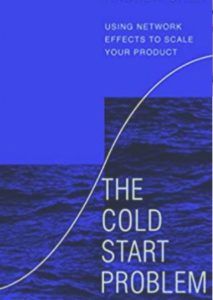
The problem is, no one knows about you or your product. How do you get those first users onboard? And how do you leverage those first users into a larger market share? Those are the questions Andrew Chen answers in his new book, “The Cold Start Problem,” which promises to explain how to start, grow and defend successful businesses.
It’s difficult to get momentum when there are no existing users, just as it’s harder to start a
car engine when it’s cold.
And if you don’t overcome this cold start problem quickly, your new product will likely die. “A network effect describes what happens when products become more valuable as more people use them,” Chen writes. Think of a dating website – it’s worthless if there are only a handful of members. But as the membership grows, the site become more valuable to both users and the site’s owner.
Many dominant businesses got their early start by serving niche markets, what Chen calls “atomic networks.” For example, Bank of America launched their first credit card just in Fresno, California in 1958 to 60,000 residents. Tinder and Facebook each started in a single college community before branching out.
Conversely, Google tried to launch its failed Google+ social network with a large-scale launch
targeting everyone rather than first establishing a successful atomic launch.
Determine who you are targeting as the first users of your product and service and then find a way to get them on board. Tinder initially threw big parties for college fraternity and sorority
members to get them to use the app. Uber offered extensive bonuses and financial incentives for its first drivers, which were targeted in very specific locations.
Says Chen, “The product idea itself should be as simple as possible – easily understandable by anyone as soon as they encounter it. At the same time, it should simultaneously bring together a rich, complex, infinite network of users that is impossible to copy by competitors.” An example is Zoom, with its simple interface and freemium model that encourages new users.
Once a product has succeeded in its atomic market, then its creators can extend it to adjacent
markets, such as other demographics or locations, until a tipping is reached and the product is a success
Buy it now here
In the beginning of his career the comedian Robin Williams couldn’t hang on to money and he made lousy business decisions.
In fact, he didn’t want to be bothered with the business end of anything. He didn’t even want to hear contract details, didn’t know how to publicise himself and despite growing fame he still took every job that came his way – even birthday parties. Can you image having Robin Williams perform at your birthday party? Holy cow. He was continually borrowing from friends and there were days when he wouldn’t have eaten if not for some kind soul inviting him to dinner.
Two things:
First, while people think his performances were spontaneous and off the cuff, most of it was not. He practiced. He worked and honed his craft like a madman. He came up with new bits, tested and tweaked them, and then tested them some more. If it worked, he reused it over and over again. If it didn’t work, he either fixed it or threw it out.
Second, he surrounded himself with people who handled the business side of everything. All he had to do was be the world-class performer he was building himself into.
What the heck does any of this have to do with marketing?
I’m so very glad you asked.
To make your business look as easy as Robin Williams spontaneously throwing out the perfect line, you’ve got to work as hard as he did. Whatever your specialty is, you’ve got to perfect it until you are one of the very best in your field. Once you do that, you can be a star in your niche and sell your products or services for enormous fees and enjoy the love and adulation of your followers. But first, you’ve got to do the work.
Second, you don’t need to be an expert on every facet of your business. Instead, you simply need to bring in people to handle things for you. Robin had an entertainment lawyer, managers, publicity agents and a host of other people who did their jobs in order to allow Robin to do his job. If your specialty is creating information products but you’re terrible at writing sales letters, recruiting affiliates and doing social media, then hire those things out to experts who can do it for you.
Focus on what you do well. Become the best at it. And build a team to handle the rest of it for you.
Read our full February Newsletter here